Not every job goes to plan from day one. Mount Vernon was one of those jobs.
A residential builder needed a full pad completed: 152 screw piles, positioned beneath load-bearing walls, wet areas, and other structurally critical sections of the build. The engineering specs were straightforward: minimum 3.3 metres depth, 70kN capacity on every single pile.
The ground had other ideas.
When the Test Piles Told Us Something Was Wrong
Before full installation begins, IdealFoundations always runs a series of test piles across the site. It is one of the most important steps in any project — it tells us exactly what the ground is doing before the real work starts.
At Mount Vernon, those tests revealed a problem early. The soil conditions across the pad were too stiff to reach the required 3.3-metre depth using the initial setup. Forcing piles into ground that isn’t ready risks falling short on torque and capacity. That is not something we are willing to accept.
So we adapted.
The Decision: Pre-Drill the Entire Pad
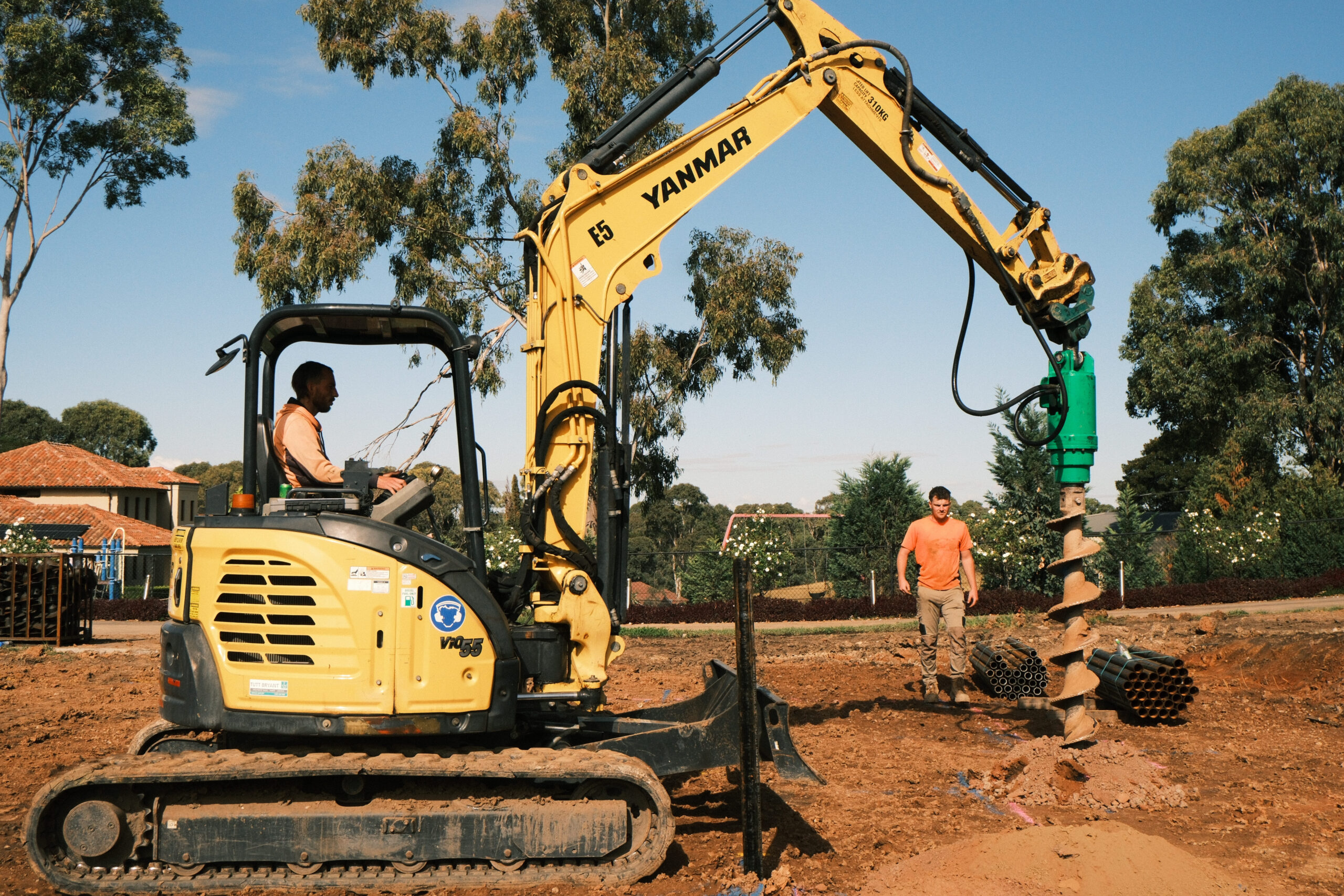
We set up the 3.5-metre auger and began drilling pilot holes to a depth of 3 metres across the entire pad footprint. Two full days of preparation before a single screw pile went in permanently.
Pre-drilling breaks up the stiff soil profile and allows each pile to be driven to the correct depth and torque. It adds time to the preparation phase — but it guarantees the outcome. And when 152 piles are going into a residential foundation, the outcome is everything.
Four Days. Every Pile to Spec.
Day one covered the full set-out of all 152 pile locations using the builder’s architectural plans, slab plan, and pier layout — then test piles, then the auger in the ground.
Day two continued pre-drilling across the pad. Between runs, excess spoil was scraped and removed, holes were backfilled for safety, and every pile location was prepped with a lead pipe and helix ready for installation.
Day three was installation day. Every pile driven to a minimum of 3.3 metres. Every pile checked for the required 70kN capacity. No shortcuts, no skipped checks.
Day four finished the remaining piles, then moved to the final stage. A laser level was used to mark each cut-off height to the engineer’s specifications. Oxy-acetylene cutting equipment brought each pile cleanly to ground level. 220 square caps were fitted across the full pad. A final clean-up left the site level, tidy, and ready for the next trade.
The Result
152 screw piles installed. Every one to specification. Site handed back clean in four days.
Not one pile missed the 3.3-metre depth requirement. Not one pile missed the 70kN capacity. The pad was finished at ground level, capped, and left ready for construction to continue.
Mount Vernon sits up a long driveway with one of the better views we have seen on a job. Leaving a pad that clean behind us made it even better.
That is the standard IdealFoundations holds on every project — whatever the ground throws at us.
Need screw pile installation for your next build? Talk to the IdealFoundations team.
Thinking about screw piles for your project?
Get an engineered, fixed-price solution designed for your site conditions.
Request a Quote