Building on sandy soil can present foundation challenges due to loose, granular ground conditions. Depending on the site, sand can be susceptible to movement, erosion and settlement, making the right foundation design important.
Screw piles for sandy soil provide a practical solution by transferring structural loads through weaker ground to suitable load-bearing soil.
1. Why Is Sandy Soil Challenging for Foundations?
Unlike cohesive soils such as clay, sandy soil consists of loose particles that can shift under load.
Ground conditions can also vary significantly with depth and across a site. This can create challenges when designing foundations for homes, commercial buildings and other structures.
A proper site assessment and soil investigation are therefore important before selecting a foundation system.
2. Why Use Screw Piles for Sandy Soil?
Screw piles can offer several advantages when building on sandy ground:
- Minimal excavation and soil disturbance
- Fast and efficient installation
- Immediate load-bearing capacity
- Suitable for a range of structural applications
- Designed around specific soil and load requirements
The helical plates on screw piles provide bearing area within the soil, while the pile configuration and installation depth can be designed according to the ground conditions.
3. How Are Screw Piles Installed in Sand?
Before installation, the soil conditions and structural requirements are assessed to determine the appropriate screw pile design.
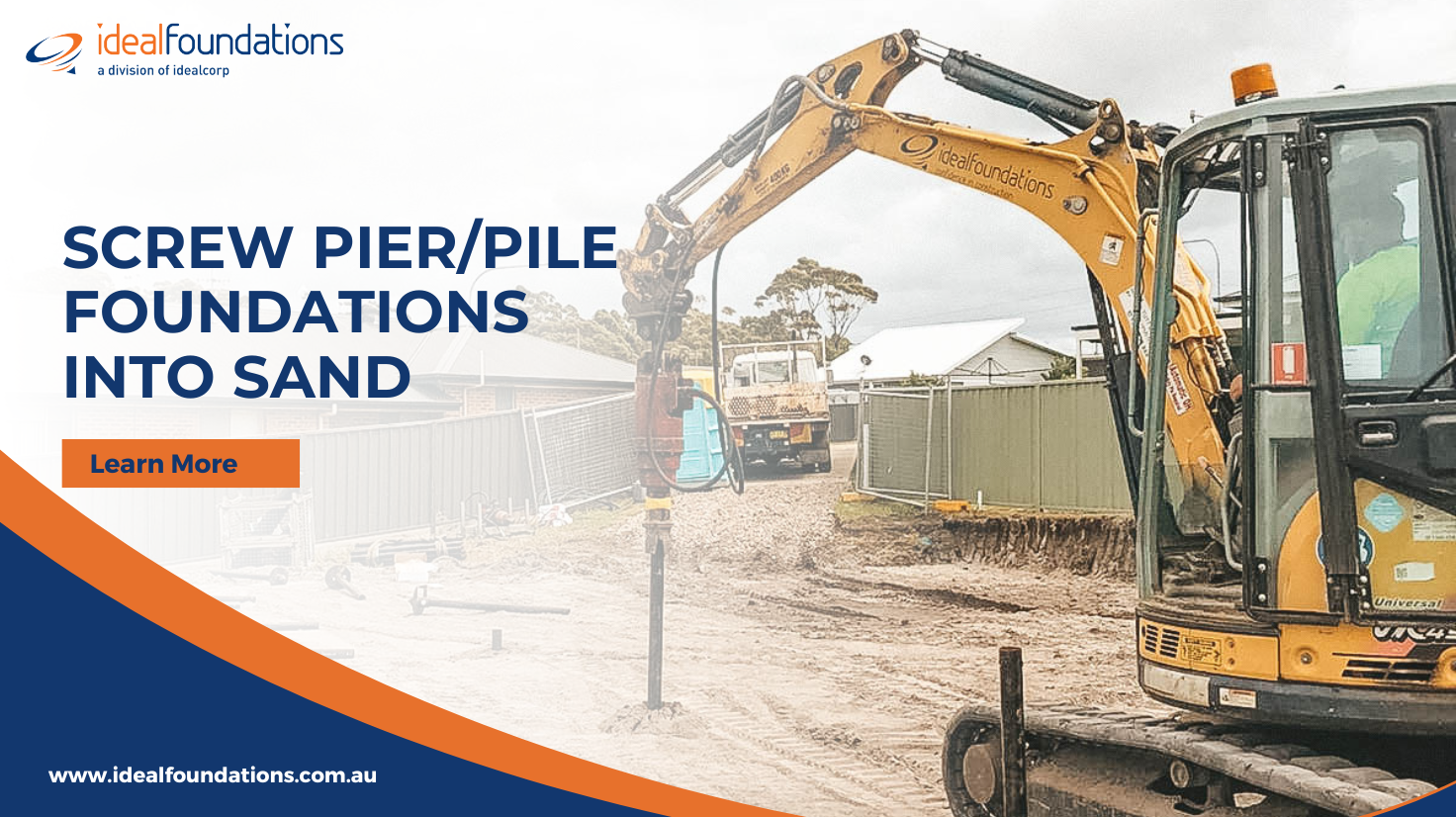
Hydraulic equipment then rotates each pile into the ground until the required installation criteria are achieved.
Installation depth, torque and other project requirements can be monitored during the process to help ensure the piles are installed according to the engineering design.
4. Where Can Screw Piles Be Used in Sandy Soil?
Screw pile foundations can be considered for a range of projects, including:
- New homes and extensions
- Commercial buildings
- Decks and outdoor structures
- Retaining structures
- Coastal projects
- Sloping sites
The appropriate pile type and configuration will depend on the ground conditions and structural requirements of each project.
5. Building on Sandy Soil?
Every site has different ground conditions, so the right foundation solution should be based on proper site information and engineering requirements.
IdealFoundations provides engineered screw pile solutions for residential and commercial projects across a range of challenging ground conditions.
Planning a project on sandy soil? Contact IdealFoundations to discuss the foundation requirements for your site.
Thinking about screw piles for your project?
Get an engineered, fixed-price solution designed for your site conditions.
Request a Quote