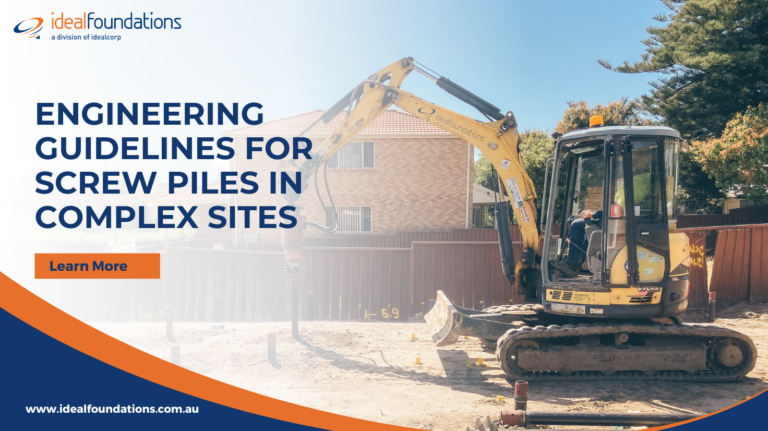
Screw piles are one of the most efficient and reliable foundation systems available today. They save time, adapt to challenging soil conditions, and provide immediate load-bearing capacity. But like any construction method, their success depends on correct design, preparation, and installation.
When mistakes occur during screw pile installation, they can lead to delays, cost overruns, and even structural risks. By understanding the most common errors, builders and engineers can avoid them and deliver safer, more efficient projects.
This article explores the top mistakes made during screw pile installation and how to prevent them.
1. Inadequate Soil Investigation
Skipping or rushing a geotechnical assessment is one of the most serious mistakes. Soil conditions vary from site to site, and without proper testing, piles may be installed at the wrong depth or with insufficient capacity.
Solution: Always begin with accurate soil testing and site classification to inform correct pile design.
2. Incorrect Load Calculations
If vertical, lateral, and uplift loads are not properly calculated, piles may fail to perform as required. Overestimating or underestimating capacity leads to unsafe or unnecessarily expensive designs.
Solution: Work with experienced engineers to confirm all load requirements before installation.
3. Using the Wrong Pile Design
Choosing standard screw piles without tailoring them to the project is a common error. Factors such as soil type, helix size, shaft diameter, and pile length must be considered.
Solution: Ensure pile designs are custom-engineered for the specific site and load conditions.
4. Poor Corrosion Protection
Installing unprotected piles in corrosive environments such as coastal regions, wetlands, or aggressive soils can shorten their lifespan dramatically.
Solution: Select galvanised or stainless steel piles where needed and factor long-term durability into the design.
5. Underpowered or Incorrect Equipment
Attempting to install screw piles with machinery that lacks the required torque capacity can cause delays or lead to piles not reaching the necessary depth.
Solution: Use appropriate hydraulic torque equipment matched to the pile size and ground conditions.
6. Failure to Monitor Installation Torque
Torque readings are the primary measure of pile performance. Ignoring them during installation risks piles that do not meet load-bearing requirements.
Solution: Continuously monitor and record torque to verify compliance with engineering specifications.
7. Overlooking Site Constraints
Restricted access, overhead services, or poor ground conditions can complicate installation. Failing to plan for these site challenges can lead to inefficiencies and safety hazards.
Solution: Conduct a thorough site assessment and plan equipment access and logistics in advance.
8. Ignoring Compliance Standards
Non-compliance with Australian Standards, such as AS 2159 for piling design and installation, exposes projects to legal, financial, and safety risks.
Solution: Ensure every aspect of screw pile design and installation meets required codes and industry standards.
9. Poor Communication Between Teams
Miscommunication between engineers, contractors, and site teams often leads to mistakes in pile placement, depth, or load requirements.
Solution: Keep documentation clear and ensure all parties are aligned before and during installation.
10. Choosing an Inexperienced Contractor
Even the best design can fail if the installation team lacks the necessary expertise. Inexperienced contractors may cut corners, fail to monitor torque, or mismanage site conditions.
Solution: Engage a contractor with proven experience and a track record of successful screw pile projects.
Conclusion
Screw piles are one of the fastest and most effective foundation systems available, but avoiding installation mistakes is essential to achieving their full benefits. From soil testing to correct equipment use and compliance with standards, each step plays a role in project success.
By learning from common mistakes and working with experienced professionals, builders and developers can ensure safe, cost-effective, and reliable foundations.
At Ideal Foundations, we engineer and install screw piers with precision, ensuring compliance, quality, and speed. Our experience helps you avoid costly mistakes and keep your projects on schedule.
Get out of the ground faster. Contact Ideal Foundations today to discuss your next project.
Thinking about screw piles for your project?
Get an engineered, fixed-price solution designed for your site conditions.
Request a Quote